1 September 2026 | 15 Minutes
Top 15 3PL Companies in India for Reliable Third-Party Logistics Services
If you’re looking for a third party warehouse, it probably means something in your current setup isn’t working quite right. Maybe your space feels limiting, maybe you’re expanding into a new market, or maybe you’ve simply outgrown where you started. Whatever the reason, you’re here for a purpose.
Choosing a warehouse isn’t just about finding empty space. The features of warehousing like how stock is stored, tracked, and moved directly affect how smoothly your operations run, how quickly customers get their orders, and how much your logistics cost over time. Get it right, and it becomes a strong advantage. Get it wrong, and it can turn into a daily headache.
This guide will walk you through what to actually look for in a modern warehouse. From storage and security to technology and value-added services, these are the features that truly make a difference when choosing the right partner.
Warehousing is the organised storage of goods in a secure, managed space and a key part of how your supply chain functions. A warehouse receives your stock, stores it properly, fulfils orders, and even handles returns. When everything runs smoothly, your operations feel seamless. When it doesn’t, the impact shows up quickly. If you want a broader picture of how warehousing fits into the larger logistics ecosystem, this overview of the logistics industry in India is a useful starting point.
Warehousing has become more important as customer expectations have changed – faster deliveries, accurate orders, and easy returns are now the norm. The right warehouse gives your business the setup needed to meet these expectations without having to build everything on your own. Understanding the benefits of warehousing can help clarify exactly how much difference the right facility makes.
At its core, every warehouse is expected to handle a few key functions: receiving goods, storing them properly, picking and packing orders, dispatching them, and managing returns. If these aren’t handled reliably, it’s not really a functional warehouse, it’s just storage space. For a deeper look at what these responsibilities involve, see our detailed breakdown of the functions of warehousing.
This is where things get more practical. These are the features you should actually look at and question when choosing a warehouse partner.
At the most basic level, a warehouse should be able to store your goods properly but it goes beyond just having space. Good storage means having the right kind of setup. This includes suitable racking systems, enough vertical space, proper floor strength, and a layout that allows goods to move easily.
Different products need different setups. Heavy pallets, hanging garments, or small consumer items can’t all be handled the same way. And as your business grows, your storage setup should be able to grow with it. If you’re unsure which kind of facility fits your needs, this guide on types of warehouses is worth a read.
EFL 3PL’s warehousing facilities are designed with flexible storage configurations, allowing businesses to store different types of goods efficiently without compromising on space or accessibility.
When your stock is stored in a warehouse, you need clear visibility on what’s there, where it is, and how much of it you have at any time. That’s what inventory management ensures.
A good warehousing partner should offer real-time visibility through systems or dashboards, so you’re never guessing. It should also support methods like FIFO (First In, First Out) or FEFO (First Expired, First Out), especially for products with shelf life.
Regular stock checks and alerts when inventory runs low help you stay prepared and avoid last-minute issues. Without proper inventory management, it becomes difficult to track stock accurately or plan ahead.
If your warehouse is handling customer orders, fulfillment becomes one of the most important things to get right. Order fulfillment covers everything from picking the right items to packing them correctly and handing them over for delivery. Speed and accuracy here directly affect customer satisfaction and return rates. For businesses selling online, e-commerce fulfillment capabilities become especially critical, as customer expectations for fast, error-free delivery are higher than ever.
When evaluating a warehouse, it’s important to understand their accuracy levels, processing time, and how they handle high-demand periods like sales or festive seasons.
A warehouse doesn’t operate in isolation; it’s part of a larger transport network. Location, connectivity, and access to major routes all affect how efficiently goods move in and out. Planning, coordination, and proper handling play a key role in ensuring smooth transitions between storage and delivery.
Planning and organising space, managing inventory, and providing climate-controlled services efficiently are all things EFL 3PL handles end-to-end ensuring goods are stored and handled with precision before moving to their next destination. When transportation and warehousing are aligned, it leads to better coordination, fewer delays, and more efficient movement overall.
For businesses dealing with large volumes, consolidation and bulk-breaking are important functions. Consolidation means combining goods from different shipments into one, while breaking bulk involves splitting large consignments into smaller, manageable orders.
Both help streamline distribution and reduce transportation costs, especially when serving multiple locations or customers. This is a core part of what a well-run distribution center handles on a daily basis.
This is where warehouses go beyond basic storage and start supporting more parts of your operations. These services reduce the need for separate processing setups, making the supply chain more efficient and easier to manage.
Warehouses nowadays provide facilities for packing, processing, and grading of goods, and EFL 3PL’s state-of-the-art warehousing solutions include value-added services that support these essential functions all under one roof, helping save time, cost, and effort.
Kitting involves combining multiple items into a single package, while assembly prepares products for final delivery. It may seem simple, but doing this at scale requires proper systems and trained teams to ensure accuracy and consistency.
Packaging helps protect goods during storage and transport, while labelling ensures proper identification and compliance. Having these services within the warehouse gives businesses more flexibility, especially when dealing with different markets or requirements.
Grading involves sorting products based on quality, size, or condition. Processing may include steps like cleaning, repacking, or preparing items for sale. Handling this within the warehouse helps reduce extra steps and keeps operations more efficient.
Before goods are shipped, quality checks ensure everything meets the required standards. EFL 3PL integrates QC protocols into its warehouse operations, giving businesses confidence that each shipment is accurate and ready. This helps reduce errors, returns, and customer complaints.
When choosing a warehouse, it’s not just about the physical space, the technology behind it matters just as much. A modern partner should have systems that give you visibility, speed, and accuracy. These are the features of warehousing that make a real difference.
A WMS acts as the backbone of warehouse operations. It tracks everything from incoming goods to outgoing orders. For businesses, this means real-time access to inventory, order tracking, and performance data all in one place. It also becomes easier to integrate with e-commerce platforms or internal systems. Some providers extend this further through systems process outsourcing, where technology management and process support are handled end-to-end by the logistics partner.
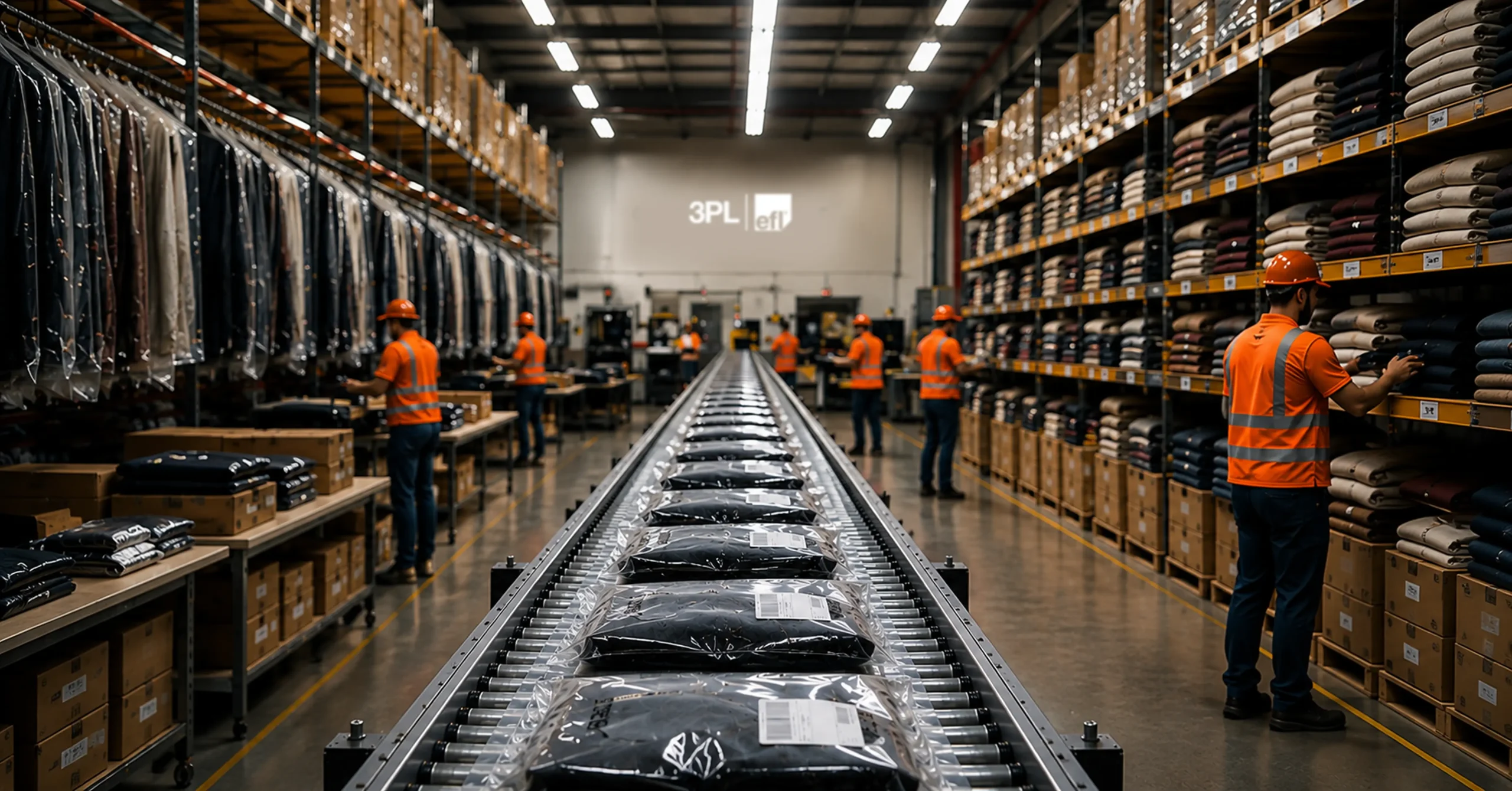
High-volume warehouses increasingly rely on automation think conveyor systems, barcode scanners, automated sorting, and sometimes even robotic picking. Automation speeds up processing, reduces errors, and keeps operations consistent, especially during peak periods when manual-only processes often struggle.
If you expect your volumes to grow significantly, check whether automation is already in place and how the facility plans to scale with your business.
Every product in a warehouse needs to be tracked. Barcode scanning and RFID (Radio Frequency Identification) technology make this fast and precise. Scanning at receiving updates stock instantly, while scanning at dispatch ensures the correct order goes out. Every movement is recorded, auditable, and visible in real time. This is what gives you the inventory accuracy and confidence you need to run your business smoothly.
A good warehouse partner doesn’t just store your goods they give you insights that help you make better decisions. Which products are moving fastest? Where are the bottlenecks in your fulfillment cycle? How does picking accuracy change month to month? Look for a partner who provides regular performance reports and proactively shares insights, not one who just sends a spreadsheet once a quarter.
Trusting a warehouse with your inventory,
possibly your most valuable business asset means the physical infrastructure, security, and other features of warehousing are crucial to protecting your goods and keeping operations smooth.
A proper warehouse should have 24/7 CCTV coverage, controlled access (keycards, biometrics, or security personnel), perimeter fencing, and motion detection. For high-value items, ask about secure zones, bonded storage, and insurance coverage. Don’t just assume to get all details in writing.
Temperature-sensitive products like pharmaceuticals, food, chemicals, or certain electronics need real climate-controlled storage with continuous monitoring, not just a basic air-conditioned room.
EFL 3PL offers climate-controlled warehousing with around-the-clock tracking of temperature and humidity. Your goods are protected, and records prove compliance with storage requirements. Planning space, managing inventory, and providing climate control is all handled with precision and care.
A warehouse without reliable power risks operations. Temperature-sensitive goods can spoil, and data-driven systems can experience downtime, delaying orders. Ask potential partners about backup power generators, UPS systems, and IT redundancy should all be in place.
Forklifts, reach trucks, pallet jacks, conveyor belts, and pick trolleys help move goods faster, safer, and with less strain. Poorly maintained or incorrect equipment slows operations and increases breakage. When visiting a facility, take note of the equipment it tells you a lot about day-to-day management.
Even the best infrastructure doesn’t matter if day-to-day operations are messy. Operational efficiency determines whether a warehouse can consistently meet service levels or falter when volumes spike.
An efficient layout minimizes picker travel, reduces congestion, and keeps high-velocity items within easy reach. Poor layout adds seconds to every pick, which multiplies across thousands of orders every month. When visiting a facility, look for logical organisation, cleanliness, and disciplined operations.
Warehouses run on people. Workforce management including scheduling, training, and productivity standards directly affects service reliability. High turnover, poor training, or understaffing during peak periods leads to missed orders and delays. Ask about team structure, handling peak surges, and their approach to training and quality.
Top-tier warehouses apply lean principles eliminating unnecessary movement, reducing wait times, minimising errors, and continuously improving. Techniques like 5S (Sort, Set in order, Shine, Standardise, Sustain) keep operations accurate without expensive upgrades. A lean warehouse is an accurate warehouse and accuracy is what your customers experience.
If you’re still weighing your options, here’s a clear summary of what the right warehousing solution delivers for your business:
| Advantage | What It Means for Your Business |
|---|---|
| Inventory buffer | Maintain stock during supply disruptions or demand spikes |
| Cost savings | Bulk purchasing and consolidated shipping lower your unit costs |
| Faster delivery | Stock positioned closer to customers speeds up last-mile |
| Risk reduction | Secure, insured storage protects your goods |
| Scalability | Flex capacity up or down as your business grows |
| Better customer experience | Accurate, on-time orders build loyalty and reduce returns |
| Compliance | Proper storage and documentation meet regulatory requirements |
| Value addition | Kitting, grading, and QC mean products are market-ready on arrival |
Understanding the importance of warehousing not as a cost to minimise, but as a capability to invest in, is what shifts the conversation. The right warehousing partner pays for itself – in efficiency, in accuracy, and in the customer trust you build over time.
If you’re looking for a warehouse, you need more than just empty space. You need a facility with the right technology, services, infrastructure, and operational discipline, the true features of warehousing is to support your growing business.
Warehousing is increasingly a strategic function. More SKUs, more markets, and more complex fulfillment needs mean your warehouse can be a launchpad or a bottleneck. The choice you make now determines which it will be. If you’re still exploring your options, this guide on warehousing companies in India can help you compare what’s available in the market.
EFL 3PL’s warehousing solutions are built for businesses serious about logistics, state-of-the-art infrastructure, integrated technology, value-added services, and experienced operations teams across India and beyond. If you want a warehouse that does more than store, this is where to start.
A warehouse mainly does five things: it receives goods, stores them safely, picks the right items when needed, packs and dispatches orders, and handles returns. When checking out a facility, make sure all five are done reliably; they’re the backbone of smooth operations.
A good WMS (Warehouse Management System) keeps track of your stock in real time, manages orders, guides pick-and-pack workflows, coordinates receiving and storage, reports on performance, and integrates with your e-commerce or ERP systems. Think of it as your live window into everything happening with your inventory.
The seven main types are public warehouses, private warehouses, bonded warehouses, distribution centres, cold storage warehouses, automated warehouses, and fulfilment centres. The right type depends on your product, your volumes, and whether you need ambient, temperature-controlled, or specialised storage.
The key pieces are physical infrastructure, inventory management systems, trained staff, material handling equipment, security systems, technology platforms, and clear operational processes. Together, these decide whether a warehouse can deliver reliable, accurate service for your business.
Consumers get faster deliveries, better product availability, and fewer order mistakes. When businesses store stock closer to customers and run efficient fulfilment operations, the shopping and returns experience improves noticeably.
Absolutely. Using a third-party warehouse, like EFL 3PL, can be one of the smartest early moves for a growing business. You get professional storage, fulfilment, and technology support without the cost of building your own facility freeing you to focus on growth.