1 September 2026 | 15 Minutes
Top 15 3PL Companies in India for Reliable Third-Party Logistics Services
Across global supply chains, the distribution center is one of the most strategically significant facilities a business can operate or access. Whether goods are moving from a manufacturing plant to a retail network or from a regional hub to an e-commerce customer, it is the distribution center that makes that movement structured, scalable, and cost-efficient. This guide covers everything businesses need to know – from definitions and workflows to technology, compliance, and how to choose the right facility.
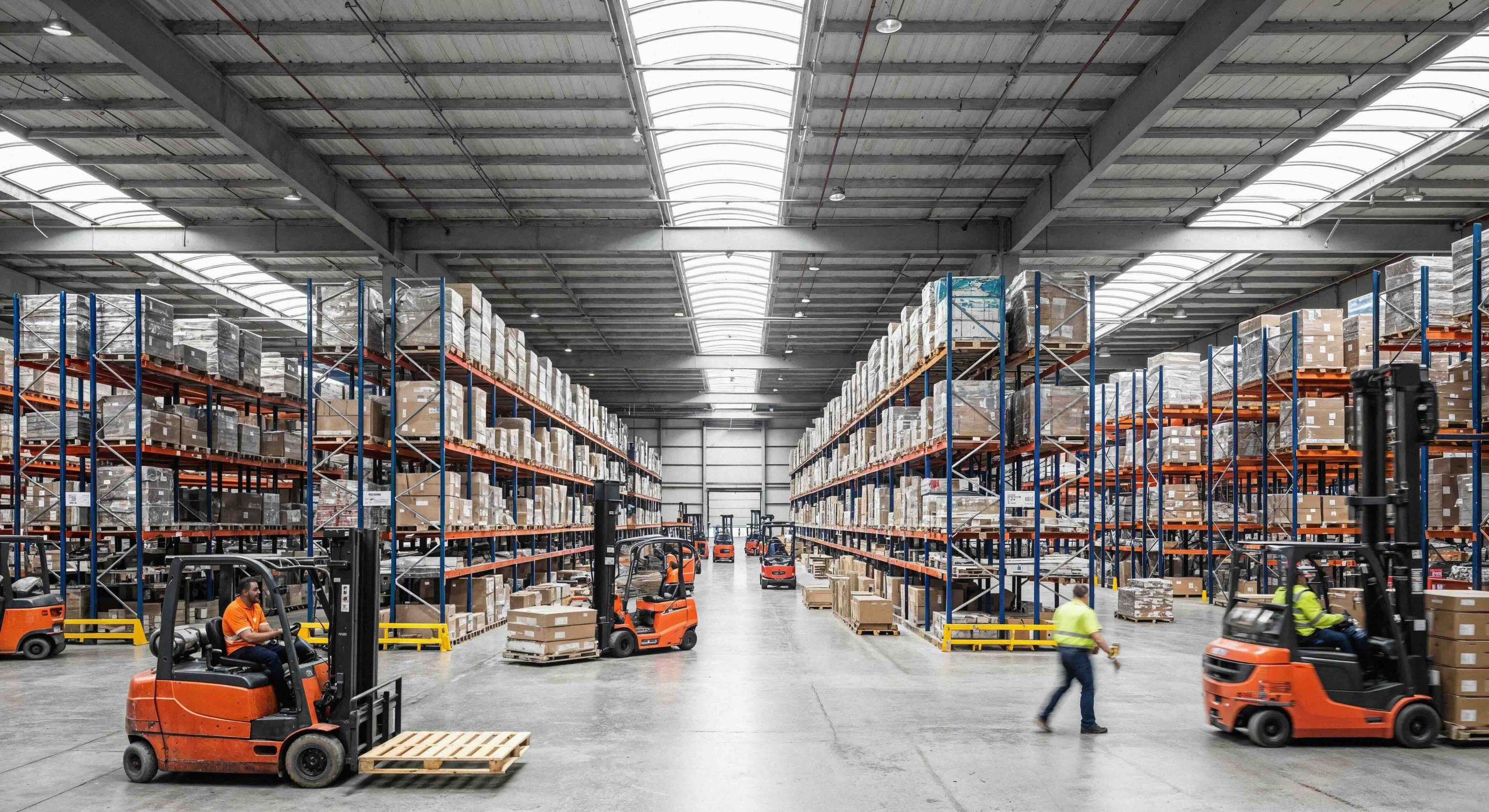
A distribution center is a specialized warehouse that serves as a hub to strategically store finished goods before they are picked, packed, and dispatched to retailers, wholesalers, or end consumers. Unlike a conventional storage facility, a distribution center is engineered for movement – it is a logistics building designed to receive and ship different types of goods, with storage functioning as a transitional step rather than the primary purpose. In practical terms, it is a facility where goods are stored, handled, and shipped, with the operational emphasis firmly on throughput speed and order accuracy.
Though often used interchangeably, these two facilities serve distinct roles. The differences come down to three core areas:
Purpose: A warehouse is primarily designed for long-term storage of raw materials or finished goods. A distribution center is purpose-built to facilitate rapid movement of finished goods toward customers or retail partners – its design, staffing, and systems are all oriented around speed of throughput.
Turnover Rate: A distribution center operates at significantly higher inventory turnover. Stock cycles through within days or hours in cross-docking models, whereas a warehouse may hold goods for weeks or months.
Core Functions: A warehouse receives and stores. A distribution center goes further – incorporating picking, packing, labeling, kitting, cross-docking, returns processing, and carrier-ready dispatch. It is the more operationally complex and strategically valuable of the two facilities.
Reduced Delivery Times: Positioning a distribution center near key demand centers or transport corridors directly shortens last-mile transit times – a critical advantage in markets where delivery speed influences purchasing decisions.
Cost Optimization: Distribution becomes more efficient at scale when operations are centralized within a well managed warehousing network. Consolidated inventory, streamlined storage systems, and optimized order fulfillment processes help reduce handling inefficiencies and lower overall logistics costs. Learn how EFL 3PL’s warehousing and contract logistics solutions enable smarter inventory control and scalable distribution.
Improved Customer Service: Disciplined inventory management, structured picking workflows, and integrated carrier coordination translate into higher order accuracy and more consistent delivery performance – both direct drivers of customer satisfaction.
Scalability: Partnering with a 3PL that operates an established distribution center network enables businesses to scale capacity – for seasonal peaks, new market entry, or SKU expansion – without proportional capital investment in owned infrastructure.
A distribution center sits between manufacturing and the end customer, functioning as a decoupling point that allows production and consumption to operate on independent schedules. Goods are manufactured in bulk, held temporarily in the distribution center, and dispatched in precise quantities as demand materializes. Across geographically complex markets like the Indian subcontinent, a strategically placed distribution center network enables national reach without excessive local inventory at every point of sale.
Inbound receiving is where the distribution process begins and where accuracy is most critical. Shipments are unloaded, verified against purchase orders, and logged into the WMS. Any discrepancies are flagged immediately. A disciplined receiving process prevents errors from compounding across all downstream operations.
Effective inventory management demands real-time visibility into the location, quantity, and velocity of every SKU. High-frequency items are slotted closest to picking zones. ABC analysis, cycle counting, and WMS-driven replenishment alerts are standard tools in a well-run distribution center. For businesses requiring specialized storage conditions, EFL 3PL offers temperature-controlled, regulatory-compliant storage solutions to ensure products are handled and stored in accordance with industry standards.
When an order is received, the WMS generates a picking list and routes it to the appropriate worker or automated system. Precision here is paramount – leading distribution centers target pick accuracy rates above 99.5%, supported by barcode scanning, RFID, and pick-to-light systems. EFL 3PL’s systems process outsourcing capabilities further enhance this accuracy by integrating WMS and ERP platforms and providing system operations across various ERP platforms.
Packed orders are sorted by carrier, route, or delivery zone, labeled with finalized shipping documentation, and loaded for dispatch. WMS integration with transportation management systems (TMS) ensures every outbound shipment is tracked from the moment it leaves the distribution center. For cross-border consignments, EFL’s freight forwarding & clearance services ensure seamless handoff across international lanes.
Pallet Racking: The most prevalent format in high-volume facilities. Multi-tiered configurations – selective, drive-in, push-back – maximize vertical space and suit varying inventory rotation needs.
Shelving Systems: Used for smaller items and SKU-intensive product ranges that require unit-level picking. Common in e-commerce and pharmaceutical distribution center operations.
Automated Storage Systems (ASRS): Computer-controlled systems that store and retrieve goods with minimal human intervention. High throughput, compact footprint – increasingly common in high-value or space-constrained environments.
Temperature-Controlled Storage: Refrigerated or frozen zones with continuous monitoring for perishables, pharmaceuticals, and dairy. Demand for cold-chain distribution center capacity is growing rapidly across South Asia, a capability EFL supports through its healthcare logistics and FMCG industry verticals.
A WMS is the operational backbone of any modern distribution center – governing inventory management in real time, directing workflows, managing labor, and integrating with ERP and e-commerce platforms to deliver end-to-end supply chain visibility.
From conveyor systems to autonomous mobile robots (AMRs) and robotic picking arms, automation improves throughput consistency, reduces picking error rates, and extends operational hours. Investment in distribution center automation across Asia-Pacific logistics markets is accelerating significantly.
Barcode scanning, RFID, and IoT sensors provide granular visibility into every unit within a distribution center. For 3PL providers managing multi-client inventories within a shared facility, real-time tracking is both an operational and a commercial necessity.
AI-powered demand forecasting enables distribution centers to pre-position inventory ahead of demand surges. Predictive maintenance and machine learning-driven pick path optimization further improve throughput, reduce downtime, and lower the cost per unit processed through the distribution process.
A distribution center becomes strategically necessary when order volumes are significant, customers are geographically dispersed, inventory management complexity has outgrown a single site, or when reducing logistics costs requires the economies of scale that only a purpose-built facility provides. For most businesses at growth stage or beyond, the question is not whether to use a distribution center – it is which model, and whether to own it or access it through a 3PL.
A well-planned distribution center layout minimizes internal travel distances, separates inbound and outbound flows, and positions high-velocity SKUs adjacent to packing and dispatch zones. Slotting optimization – determining where each product lives inside the facility – should be revisited regularly as demand patterns evolve.
Clear standard operating procedures (SOPs) for every process stage – receiving, put-away, picking, packing, and dispatch – ensure operational consistency and reduce reliance on individual knowledge. Purpose-designed cross-docking lanes, kitting areas, and return zones are hallmarks of a well-engineered distribution center.
Proper aisle widths, weight-rated racking, fire suppression infrastructure, and documented emergency procedures are non-negotiable. In the Indian subcontinent, distribution center operators must comply with applicable national and state-level safety legislation, labor laws, and sector-specific regulatory requirements.
Receiving associates, pickers, packers, forklift operators, and dock supervisors form the operational core. These roles are process-intensive and directly determine throughput speed, accuracy, and cost-efficiency.
Inventory analysts, WMS administrators, replenishment planners, and dispatch coordinators maintain the accuracy of inventory management systems, manage carrier relationships, and ensure operational data reflects ground reality in real time.
Distribution center managers, operations directors, and supply chain planners are accountable for facility KPIs – order fulfillment accuracy, throughput rates, cost-per-unit, and safety compliance – as well as client SLA management and continuous improvement.
In India, distribution center operators must comply with the Factories Act, the Contract Labour (Regulation and Abolition) Act, applicable Minimum Wages Act provisions, and the emerging consolidated Labour Codes. 3PL operators managing large-scale facilities typically maintain dedicated compliance functions to navigate evolving requirements across jurisdictions.
Regular safety audits, mandatory PPE enforcement, certified equipment operation, and documented emergency response procedures are standard requirements. Non-compliance carries legal penalties, operational disruption risk, and serious worker safety consequences. EFL’s compliance page details the full range of certifications and audit standards maintained across its distribution network.
In several mature logistics markets, regulations around warehouse productivity targets are under active legislative review. Responsible distribution center operators adopt transparent, evidence-based frameworks that balance operational efficiency with worker wellbeing – and should monitor regulatory developments in this area proactively.
Leading global 3PL providers operate multi-node distribution center networks that give multinational clients access to world-class logistics infrastructure without owning it. These networks feature standardized WMS technology, multi-client facility configurations, and SLAs covering order fulfillment accuracy and dispatch timeliness – enabling faster market entry and lower capital risk than greenfield infrastructure investment.
Across the Indian subcontinent, a new generation of integrated logistics platforms is combining large-scale warehousing with distribution center management capabilities under a unified technology and operations framework. For sophisticated shippers – from FMCG multinationals to high-volume e-commerce brands – this model provides end-to-end supply chain control from a single provider, eliminating the coordination friction of managing warehousing and distribution separately. EFL’s extending this further, offering strategic supply chain orchestration across the entire logistics network.
Positioning inventory in a distribution center near customer demand clusters reduces both transit time and shipping cost. Fewer shipping zones mean lower carrier rates and faster delivery – a direct commercial advantage in markets where delivery speed is a primary purchase driver.
High-volume e-commerce operations route orders to the distribution center closest to the delivery address, reducing average shipping distance and building supply chain resilience. If one node faces disruption, volume is redistributed across the network without service degradation.
A distribution center with a structured reverse logistics process handles returns efficiently – inspecting, restocking viable items, and disposing of others. A clean returns workflow improves customer experience and reduces the capital tied up in unprocessed returned inventory.
A distribution center is not simply a warehouse facility designed to store and move products in bulk quantities. It is a precision-engineered operational asset that determines how fast, how accurately, and how cost-effectively a business serves its customers. For companies navigating the geographic scale, infrastructure complexity, and rising consumer expectations of the Indian subcontinent – and broader South Asian markets – access to high-performance distribution center infrastructure is no longer optional.
Whether through owned facilities, a 3PL-operated network, or an integrated warehousing and distribution platform, the fundamentals are constant: strategic location, disciplined inventory management, technology-enabled operations, and an unwavering focus on order fulfillment speed and accuracy. These are the pillars of a distribution center that genuinely move a business forward.
A distribution center is a specialized facility focused on receiving finished goods and dispatching them rapidly to retailers or end customers. A warehouse focuses on longer-term storage. The key difference is purpose: a distribution center is engineered for movement and order fulfillment; a warehouse is engineered for storage capacity.
A distribution center works through a structured inbound-to-outbound workflow: goods are received, logged into the WMS, assigned storage locations, retrieved when orders are placed, packed and labeled, and shipped via carrier partners – with every step governed by inventory management rules and real-time tracking.
Delivery speed. By positioning a distribution center strategically close to customer markets, businesses reduce transit times and last-mile costs – directly improving customer satisfaction and competitive positioning in markets where fast delivery drives purchase decisions.
A distribution center is a warehouse facility designed to store and move products in bulk or small quantities, serving as the operational hub between a supplier or manufacturer and the end customer – where inventory is received, briefly held, and dispatched as part of the order fulfillment cycle.
A distribution centre (British English) refers to the same type of specialized logistics hub – a facility that receives goods, manages them through disciplined inventory management, and redistributes them efficiently to downstream destinations. The term is interchangeable with distribution center in professional practice.
In logistics, DC stands for Distribution Center – the facility from which goods are processed and dispatched toward their final destination. When a tracking update references a DC, it indicates the shipment has cleared the central distribution hub and is moving outward through the carrier network.
In supply chain management, a DC (Distribution Center) is the node that bridges production and consumption – holding finished goods inventory centrally and distributing it in precise quantities as orders are received. For 3PL providers, an efficient DC network is one of the most valuable capabilities they offer clients, providing logistics reach and infrastructure that would take years to replicate independently.